
How to Remove Green Algae From Vinyl Siding
The short answer
Green algae on vinyl siding is best removed by soft washing: a low-pressure application of a biodegradable cleaning solution that kills the algae at the root, followed by a gentle top-down rinse. Skip the high-pressure blasting, which can force water behind the panels and only strips the surface growth, so the green returns within months.
Is it algae, mildew, or mold?
When your siding turns green, you are almost always looking at algae. Algae is a plant-like, photosynthetic organism, not a fungus, so it needs light to grow. That is why it spreads as a thin green-to-black film across the broad, open faces of your siding rather than hiding in dark corners. Given moisture and a little indirect light, it will keep expanding season after season.
Mildew and mold are different. Mildew shows up as lighter gray, white, or slightly fuzzy patches and is a fungus that prefers darker, damp spots. Mold tends to be darker and can work deeper into porous materials. Black streaks running down from the roofline are often something else again: roof algae (the same Gloeocapsa magma behind dark streaks on asphalt shingles) rinsing down onto the wall, or mildew.
Telling them apart matters because it points to the real source. Green algae responds well to a proper soft wash, but if the staining is coming off the roof or out of an overflowing gutter, cleaning the siding by itself is only a temporary fix until you address what is feeding it.
Why algae claims the north and shaded walls first
Algae needs two things to take hold: steady moisture and enough light to photosynthesize. North-facing and tree-shaded walls get the least direct sun, so morning dew, rain, and humidity linger on them for hours instead of burning off. That damp, shaded band is exactly where airborne spores and rain splash settle and multiply, which is why one elevation of a house can be vivid green while the sunny south wall looks clean.
The Connecticut River valley makes this worse than average. Humid Pioneer Valley summers, a heavy mature tree canopy, and older Longmeadow and Hampden County lots with big oaks and maples close to the house all keep the shaded elevations wet. Overhanging limbs drip onto the siding and block the airflow that would otherwise dry it, while leaf litter and spring pollen give the colony extra organic matter to feed on.
Gutters and downspouts play a quiet role too. Where they overflow or dump against the wall, they keep a vertical stripe of siding constantly damp, and that stripe is often the first place you will notice the green creeping in.
The safe way to remove it: soft washing that kills at the root
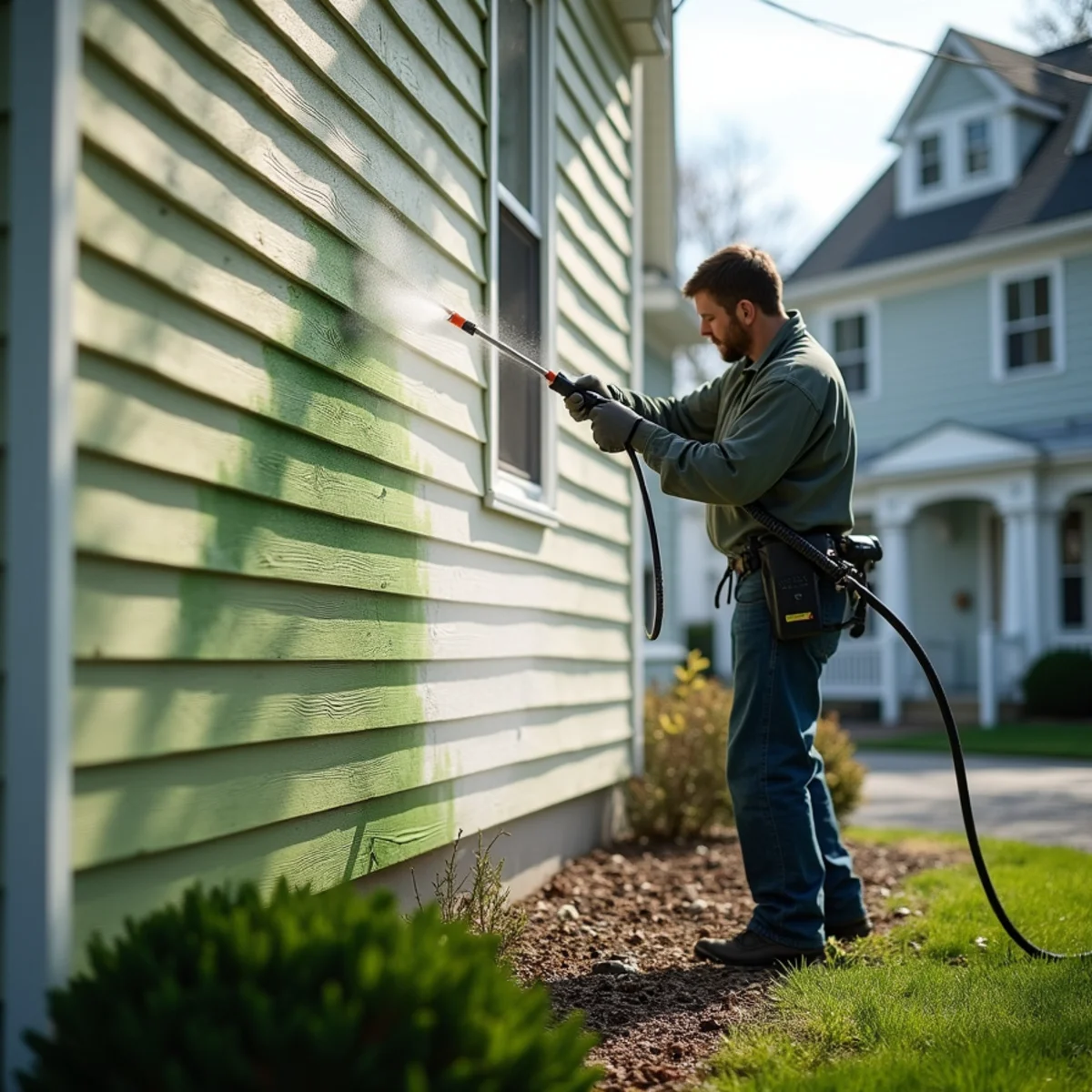
Soft washing is the method built for this. It applies a biodegradable cleaning solution, surfactants combined with a controlled, diluted amount of sodium hypochlorite matched to the surface and to how heavy the growth is, at low pressure. The solution is left to dwell for a few minutes so it can break down the biofilm and kill the organism at the root, and then the wall is rinsed from the top down at roughly garden-hose pressure.
The key difference is what happens below the surface. Because the algae is killed rather than simply knocked loose, the wall is not just clean-looking, it is clean down to the root. That is why a soft wash keeps siding clear far longer than a plain rinse that only removes the top layer and leaves living growth behind to return.
Low pressure is the whole point. The chemistry does the cleaning, so the water pressure at the wall is closer to a strong garden hose than to a jet. On delicate surfaces like vinyl siding, that gentle approach is what lets you get a deep clean without the risks that come with force.
Why blasting it off with a pressure washer backfires
It is tempting to point a rented pressure washer at the green and let force do the work, but vinyl siding is water-resistant, not waterproof. A narrow high-pressure jet aimed upward or into the seams and laps can drive water behind the panels, where it has no easy way back out. Trapped moisture invites mold, mildew, and even rot inside the wall cavity, which is the opposite of what you set out to fix.
A New England winter adds a second hazard. Water that works its way behind siding in the fall can freeze and expand during a cold snap, and repeated freeze-thaw cycles stress panels and fasteners over time. High pressure can also crack, chip, or warp the vinyl itself and blast the caulk loose at the trim. Many siding manufacturers warn against high-pressure washing for exactly these reasons.
On top of the damage risk, pressure only removes what is on the surface. The living algae underneath survives and comes right back, often within a single season, so you take on all the risk of pressure washing and still end up rewashing the same wall.
Do DIY methods like vinegar and bleach work?
For a small, light patch you can reach safely, a homeowner mix can help. A white-vinegar-and-water solution will lift light green film, and an oxygen-bleach (sodium percarbonate) solution is a gentler choice around plants because it breaks down into oxygen and soda ash rather than lingering as a harsh residue. Both are best for minor, isolated spots.
Chlorine bleach straight from the store does kill algae, but without the right dilution, a surfactant to help it cling and dwell, and disciplined plant protection, it tends to run off and scorch landscaping, leave streaks, and still miss the root when it is rinsed away too quickly. Effective is not the same as controlled.
The bigger DIY obstacles are reach and consistency. Getting even coverage across a two-story shaded gable usually means ladders and a level of control most homeowners cannot manage, and a garden-hose rinse that is too weak leaves live algae behind while a rented pressure washer reintroduces the water-intrusion risk above. The honest bottom line: DIY can buy time on a small area, but a full, shaded elevation is where a proper soft wash earns its keep.
Protecting your plants and what to expect from the results
Any treatment strong enough to kill algae has to be managed around your landscaping. Before any solution is applied, the beds, shrubs, and lawn along the wall are pre-wet so the cleaning mix cannot concentrate on the foliage, and everything is rinsed again afterward. That deliberate dilution before, during, and after is what keeps plants safe, and skipping it is the main reason DIY bleach jobs burn landscaping.
It is also worth setting honest expectations. Soft washing restores the siding and slows regrowth, but nothing makes vinyl permanently algae-proof. The shade and moisture that invited the algae are still there, so the growth is reset, not banished for good. On heavily shaded, north-valley homes, a light annual maintenance wash is what keeps it from taking hold again between deeper cleanings.
How to keep green algae from coming back
The most effective prevention is cutting off the moisture and shade the algae depends on. Trim tree limbs and shrubs back off the siding so sunlight and air can reach the wall and dry it faster after rain and dew. Better airflow alone makes a shaded elevation far less hospitable.
Keep your gutters and downspouts clear and pointed away from the wall so you are not feeding a permanent wet stripe down the siding. Address the upstream source too: if black streaks are washing down from the roof, cleaning the siding on its own is only temporary until the roof algae is handled.
Then stay on a sensible maintenance cadence. For most Hampden County homes, an annual house wash is the sweet spot, and damp, heavily tree-shaded lots sometimes benefit from a mid-season touch-up on the north-facing walls. If you would rather have it handled, Craft Bros Exterior Cleaning soft washes vinyl siding across Longmeadow and the surrounding Pioneer Valley; for a free estimate, call (351) 242-0666.
Craft Bros Exterior Cleaning
Local exterior-cleaning specialists serving Longmeadow and Hampden County. Questions about your home? Call (351) 242-0666.