
Why Asphalt Roofs Should Never Be Pressure Washed
The short answer
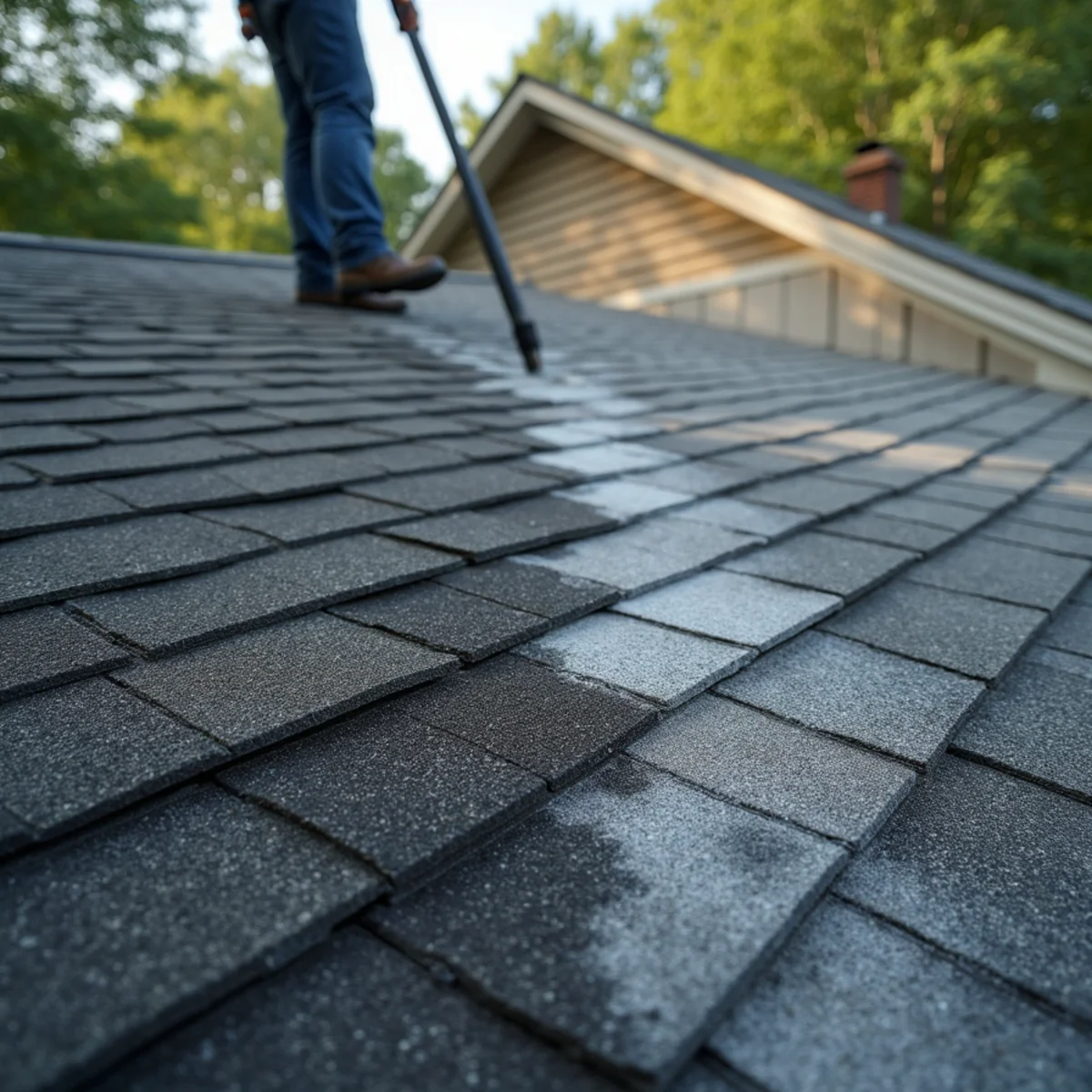
High pressure blasts the protective granules off asphalt shingles, exposing the asphalt to UV, shortening the roof's life, and voiding most manufacturer warranties. It can also drive water under the shingles and cause leaks. Asphalt roofs should only be soft washed, using a low-pressure cleaning solution that kills the algae and moss at the root without touching the shingle.
What pressure washing actually does to asphalt shingles
Every asphalt shingle is coated with a layer of mineral granules, and those granules are not decorative. They shield the asphalt underneath from ultraviolet light and weather, and they are the single biggest factor in how long the roof lasts. A pressure washer aimed at that surface behaves like a sandblaster: the concentrated stream scours the granules loose and washes them into the gutters. The roof can look clean the day it is done and still be years closer to failure, because the exposed asphalt now bakes and cracks in the sun far faster than it should.
The damage does not stop at the surface. High-pressure water finds its way under shingle tabs and up beneath the flashing, where it can loosen nails, break the factory seal between shingles, and push moisture into the roof deck. In an attic that shows up later as staining, mold, or rotted sheathing, and none of it is obvious from the ground on the day of the wash. Add the plain physical danger of standing on a wet, sloped roof with a kickback-prone wand, and pressure washing an asphalt roof is a bad trade on every axis.
In our part of New England the stakes are higher still. Once granules are stripped, the bare asphalt absorbs water more readily, and our winter freeze-thaw cycles then expand that trapped moisture again and again. A roof that might have reached its full rated life can start shedding shingles and leaking a few seasons after a single aggressive cleaning.
The black streaks are alive, and blasting them does not kill them
Those dark vertical streaks are not dirt or soot. They are a colony of a hardy blue-green cyanobacteria called Gloeocapsa magma, an ancient photosynthesizing organism that has settled into the shingle. Modern fiberglass-reinforced asphalt shingles use limestone as a filler and ballast, and Gloeocapsa magma feeds directly on that calcium carbonate. The colony builds a dark, UV-protective sheath as it grows, which is the black stain you see, and it spreads downward with the rain, which is why the streaks run in vertical stripes from the ridge.
Because the problem is a living organism, you cannot solve it by removing the surface. Pressure washing knocks off the visible top layer of stain along with a load of granules, but it leaves the roots and spores behind, so the streaks return within a season or two, now on a roof you have already damaged. The only durable fix is to kill the organism itself, and that is a chemistry problem, not a pressure problem.
Why pressure washing voids your shingle warranty
This is not just our opinion. The Asphalt Roofing Manufacturers Association, the industry body whose standards the major brands follow, publishes a technical bulletin on algae discoloration that tells homeowners in plain terms never to use a pressure washer on an asphalt roof, because it causes granule loss and very likely premature failure of the roof system. The largest shingle makers, including GAF, Owens Corning, and CertainTeed, echo that warning in their own literature.
Granule loss is exactly the kind of damage a manufacturer's warranty is written to exclude. If a shingle fails early and an inspector finds the granules scoured away, the claim is usually denied on the grounds that the roof was cleaned improperly. So pressure washing can cost you twice: once for the shortened roof life, and again for the coverage you thought you had. Soft washing, by contrast, is the method those same manufacturers point to as acceptable.
Soft washing: the method roof manufacturers actually endorse
Soft washing is the low-pressure alternative built for delicate surfaces like a roof. Instead of relying on force, it relies on a cleaning solution: a biodegradable blend of surfactants and a controlled dose of sodium hypochlorite, applied at a pressure no stronger than a garden hose. The solution is laid onto the shingles, given time to dwell so it can penetrate and kill the algae, moss, and lichen at the root, and then rinsed gently. Nothing scrubs, and nothing scours.
The approach mirrors what ARMA itself describes, which is a diluted chlorine solution allowed to sit for roughly fifteen to twenty minutes and then rinsed with low pressure, never a pressure washer. Done correctly, it clears the streaks and, because the organism is killed rather than merely knocked back, it slows how quickly the growth returns. We work from ladders and safe positions rather than walking the roof wherever we can avoid it, pre-wet and protect the landscaping and gutters below, and let the solution do the work instead of the water.
Honest expectation setting matters here. Soft washing restores the roof and buys you clean, streak-free years, but no roof stays pristine forever in a damp climate. Regrowth is slowed, not stopped, and a periodic maintenance wash keeps it in check far more cheaply than any repair.
Moss and lichen need a gentler hand than algae
Algae stains the surface, but moss and lichen dig in, and they call for even more patience. Moss holds a sponge of moisture against the shingle and sends rootlike structures under the tabs, prying them up. Each winter, the water trapped in those lifted gaps freezes, expands, and widens the opening a little more, which is how moss quietly turns into leaks over several New England winters. Lichen bonds even more tightly, forming crusty patches that resist quick removal.
The temptation is to scrape, wire-brush, or blast these growths off, and all three are mistakes on an asphalt roof. Scraping and brushing tear granules away just like pressure does. The correct method is to treat the moss and lichen with a soft-wash solution, let it kill the growth, and let the weather and gentle rinsing release the dead material over the following weeks. It is slower than blasting, and it is the only approach that leaves the shingle intact.
Why Connecticut River valley roofs streak in the first place
If your roof in Longmeadow, Wilbraham, Hampden, or anywhere across Hampden County is streaking, you are not doing anything wrong; the local climate is simply ideal for roof organisms. Our Pioneer Valley summers are humid, the region carries a heavy mature tree canopy, and shaded north-facing slopes stay damp long after the rest of the roof has dried. Damp shade plus airborne spores is exactly what Gloeocapsa magma, moss, and lichen need to take hold.
You will often see the growth appear first on the north side and under overhanging branches, then spread. It tends to arrive faster on homes tucked into the tree line than on those in full sun. Because the same conditions return every year, roof growth here is a maintenance reality rather than a one-time event, which is all the more reason to clean it with a method that protects the shingle instead of degrading it.
Keeping your roof cleaner for longer
A few practical habits extend the life of a good soft wash. Trim back branches that shade and drip onto the roof, keep the gutters and roof valleys clear of leaf litter that holds moisture, and address any spots where debris collects. On roofs prone to fast regrowth, a strip of zinc or copper installed near the ridge can help: rainwater carries trace metal ions down the slope that make the surface less hospitable to algae and moss between cleanings. Some homeowners also choose algae-resistant shingles with copper-infused granules when the time comes to replace the roof.
How often you need a professional cleaning depends on your specific roof. In a humid, tree-shaded New England setting, many homes benefit from attention every couple of years, while a sunnier, more exposed roof can go longer. The cost of that cleaning is driven by the size and pitch of the roof, the number of stories, how safely we can access it, and how heavy the growth has become, so the fair way to price it is to look at your actual roof. For a free estimate and a straight answer about whether your roof needs a wash yet, call Craft Bros Exterior Cleaning at (351) 242-0666.
Craft Bros Exterior Cleaning
Local exterior-cleaning specialists serving Longmeadow and Hampden County. Questions about your home? Call (351) 242-0666.